

Most guides to quitting smoking tell you what to buy. Very few tell you what the next four weeks will actually feel like, which is a shame, because that is where most attempts quietly fall apart. People expect the cravings. They do not expect the irritability, the sudden cough, or the strange flatness around day three that makes reaching for a cigarette feel entirely reasonable.
This is an honest week-by-week account of what to expect when you switch from cigarettes to vaping, why each stage happens, and what actually helps. None of it is dramatic, and all of it passes.
Why the first month is the one that counts
There is a good reason to focus on these particular four weeks. NHS guidance notes that if you can reach 28 days smoke-free, you are around five times more likely to stay off cigarettes for good. That is a remarkably large payoff for a relatively short stretch of discomfort, and it reframes the first month as something to get through rather than a permanent new normal.
It is also worth being clear about what vaping is and is not. The NHS supports vaping as a tool to stop smoking because it delivers nicotine without burning tobacco, which is where the overwhelming majority of smoking’s harm comes from. It is not risk-free, and it is intended for existing smokers rather than anyone else. Used properly, though, it is one of the more effective routes away from cigarettes available in the UK.
The first month, week by week
Days one to three: the steep bit
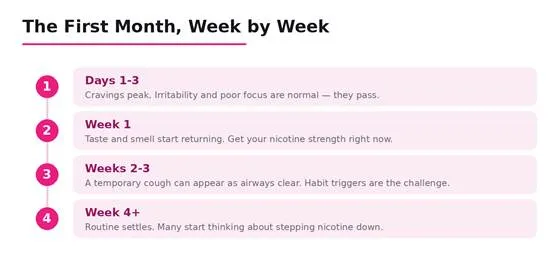
Withdrawal begins within a few hours of your last cigarette and, according to NHS guidance, is at its most intense during the first three days. Expect strong cravings, a short fuse, difficulty concentrating and possibly disturbed sleep. Some people feel restless; others feel unexpectedly flat. None of this means the switch is failing. It means your body is adjusting.
The single most useful thing to know here is that an individual craving typically lasts only ten to fifteen minutes, even when it feels bottomless. It will pass whether or not you act on it. Having the vape genuinely to hand matters enormously in these three days, because a craving met after a twenty-minute search for your device has already had time to win.
Practical things that help: drink more water than usual, go easy on caffeine, since it hangs around longer in your system once you stop smoking, and get outside for a short walk when restlessness peaks. Try not to schedule anything that demands intense concentration on day two or three if you can avoid it.
Week one: get your nicotine level right
Once the sharpest edge comes off, the priority becomes matching your nicotine strength to your old habit. This is the most common point of failure in the whole process. Go too low and you will vape constantly, still feel unsatisfied, and eventually decide vaping does not work for you. Go too high and you may feel queasy or light-headed.
NHS advice is straightforward here: pick a strength that reflects how much and how often you actually smoked. In the UK, nicotine e-liquid is capped at 20mg per millilitre, or 2 percent. Heavier smokers and anyone coming across from disposables usually start at that 20mg ceiling, moderate smokers at around 10mg, and lighter smokers lower still. Adjust within the first week rather than persevering with a strength that clearly is not working.
The other thing that happens this week is more pleasant: taste and smell begin returning. Food gets noticeably better, which is welcome, though it can also nudge appetite upwards. Worth being aware of rather than worried about.
Weeks two and three: the cough and the habit
Somewhere in this stretch, a fair number of people develop a temporary cough and assume something has gone wrong. It is a recognised part of stopping smoking: as the airways start clearing, they become more active again. It is a sign of recovery rather than damage, and it settles. If a cough is severe or persists well beyond a few weeks, that is worth raising with a GP, but a short-lived one is expected.
The bigger challenge in weeks two and three is not chemical, it is behavioural. The physical withdrawal is easing, but the habits are still fully intact: the cigarette with coffee, the one after eating, the one that punctuated a work break, the one that came automatically with a drink. These triggers arrive on schedule and can catch you off guard precisely because you feel like the hard part is over.
The fix is to change the shape of those moments rather than to rely on willpower. Take your break somewhere different, keep the vape where the cigarettes used to live, and be especially deliberate about the first social occasion involving alcohol, which is where a very large share of relapses happen. Deciding in advance what you will do is far more effective than deciding in the moment.
Week four and beyond: it gets quiet
By the fourth week most people report that the whole thing has become unremarkable. Withdrawal symptoms typically last three to four weeks on average, though some people feel them for longer, and by now the vape is simply part of the day rather than a constant negotiation. This is when you have hit the 28-day mark that makes staying quit so much more likely.
It is also the point at which many people start thinking about stepping their nicotine down, moving from 20mg to 10mg and, eventually, lower. There is no obligation to rush this. Staying off cigarettes is the goal that matters most, and reducing nicotine is a separate project best attempted once the first one feels secure.
If you slip
Plenty of people have a cigarette at some point in the first month. What determines the outcome is what happens next. Treating one cigarette as proof the attempt has failed is what turns a slip into a return to smoking; treating it as a single bad moment, noting what triggered it, and carrying on is what keeps the switch alive.
Do be aware that even occasional cigarettes tend to pull you back into the cycle of craving and withdrawal, so the aim is genuinely zero rather than a few here and there. But a slip is information, not a verdict.
Five things that catch people out
A handful of small, avoidable problems account for a surprising share of failed switches. The first is treating the vape as an emergency measure rather than a replacement, using it only when a craving becomes unbearable. Used that way it will always feel like a poor substitute. Using it steadily through the day, the way you would have smoked, works far better.
The second is puffing on it like a cigarette. Vaping rewards slower, gentler draws; hard, rapid pulls tend to produce a harsh hit and, on some devices, a burnt taste. The third is expecting tobacco flavours to taste like your old brand. They almost never do, and disappointment at that point often gets misread as vaping simply not working. Most long-term switchers settle on fruit or menthol regardless of what they expected.
The fourth is neglecting the device. A pod that has run low, or a coil left to dry out, produces exactly the unpleasant burnt taste that makes people give up, when the actual fix takes thirty seconds. The fifth is going it alone when free help is available, which is the most avoidable of the lot.
None of these are complicated, but each one has ended plenty of otherwise promising attempts within the first fortnight.
Setting yourself up properly
Most of the practical failures in a first month come down to setup rather than resolve: the wrong strength, a device that is awkward to carry, or running out of pods on a Sunday evening. It is worth reading a proper step-by-step switching guide before your quit date so the mechanics are settled in advance, and buying a spare pod or bottle from the outset so that running out never becomes the reason you buy cigarettes.
Device choice matters less than people assume, but it is not irrelevant. What you want is something simple, reliable and pocketable, with a draw that feels close to a cigarette, rather than anything elaborate. Shortlists of vapes aimed specifically at quitting smoking are a reasonable starting point, since they tend to prioritise exactly those qualities. Whatever you pick, use it every day; the NHS is clear that consistent daily use is what makes the switch stick.
Get support, and buy sensibly
One statistic deserves more attention than it gets: nearly two-thirds of people who combine a vape with help from a local Stop Smoking Service succeed in quitting. These services are free across the UK, and they will help with strength, technique and the behavioural side. If you take one piece of advice from this article, make it that one, because it roughly doubles what most people manage alone.
On the buying side, stick to established UK retailers, whether that is a specialist shop, a pharmacy or a reputable online store such as Pink Vape. Products sold legally here are covered by UK safety and quality regulations, which is not something you can assume of grey-market imports. It also means you can reliably get the same pods again in a month, which matters more than it sounds when consistency is the whole game.
The honest summary
The first three days are genuinely unpleasant, the first week is about getting your nicotine strength right, weeks two and three are about rebuilding habits, and by week four it has usually stopped being a daily event. Knowing that shape in advance makes each stage far easier to sit with, because nothing that happens comes as a surprise.
If you are reading this while still smoking and weighing it up, the practical advice is simple. Pick a start date, sort your device and strength beforehand, book in with your local Stop Smoking Service, and plan for the first three days rather than hoping they go smoothly. Four weeks is not very long, and on the other side of it the odds shift decisively in your favour.
