
Quick Answer
If you need waterproof, budget-friendly flooring that installs fast, SPC flooring supplier in dubai is usually the better fit for homes and light commercial spaces in Dubai. If you need a seamless, chemical-resistant, heavy-duty surface for garages, warehouses, or clinics, resin flooring is the stronger choice. Both perform well in Dubai’s heat and humidity, but they solve different problems — one is a floating floor system, the other is a poured, bonded coating. Risala Furniture and Interiors LLC supplies and installs both across Dubai and the wider UAE.
Key Facts Table
| Factor | SPC Flooring | Resin Flooring |
| Core material | Limestone powder + PVC composite | Epoxy, polyurethane, or MMA resin |
| Water resistance | 100% waterproof core | Fully seamless, waterproof once cured |
| Typical thickness | 4–7 mm (plus wear layer) | 2–5 mm applied coating |
| Best for | Homes, offices, retail, villas | Garages, workshops, labs, industrial floors |
| Installation method | Click-lock, floating floor | Poured and troweled, bonded to substrate |
| Heat tolerance | Good, stable under UAE indoor temps | Excellent, handles heavy foot and vehicle traffic |
| Maintenance | Sweep, damp mop | Sweep, occasional resealing |
| Lifespan (typical) | 10–20 years | 10–15 years, longer with recoating |
Introduction
Choosing the right floor dubai in a city like Dubai isn’t just about looks. Between the heat outside, air-conditioned interiors, sandy dust, and humidity swings, flooring materials get tested constantly. Two options have become especially popular across Dubai homes and businesses in recent years: SPC flooring and resin flooring. Both are durable, both handle moisture well, and both are available through Dubai-based suppliers — but they’re built for different jobs. This guide breaks down what each material actually is, where it performs best, and how to decide between them, with practical input from Risala Furniture and Interiors LLC’s flooring team.
What Is SPC Flooring?
SPC stands for Stone Plastic Composite. It’s a rigid-core vinyl flooring made by combining limestone powder with stabilizers and PVC, then topped with a printed design layer and a clear wear layer. Unlike traditional laminate, SPC has no wood content, which means it doesn’t swell or warp when it gets wet.
Why it works well in Dubai:
- Fully waterproof core, so it’s safe near kitchens, bathrooms, and balconies
- Dimensionally stable under the temperature swings between air-conditioned interiors and warm exteriors
- Click-lock installation means less downtime during fit-outs
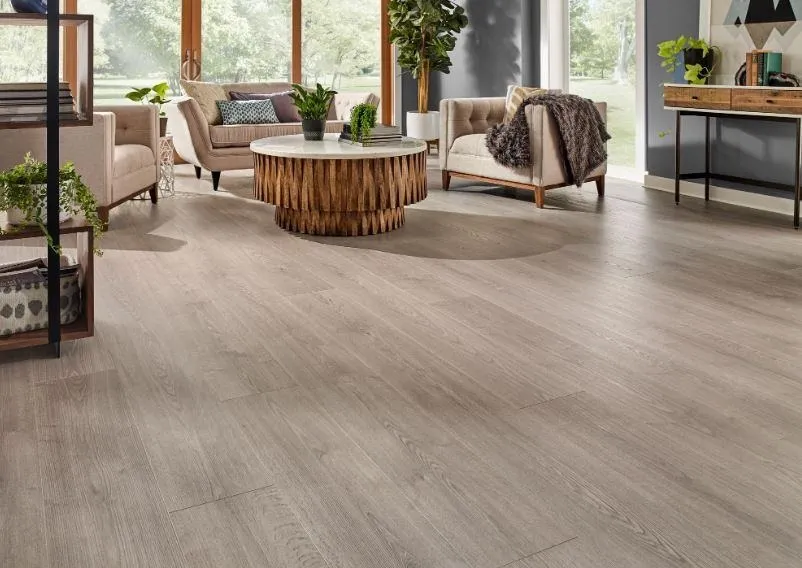
- Available in wood-look, stone-look, and tile-look finishes, popular in Dubai apartments and villas
Where SPC Flooring Is Typically Used
- Residential apartments and villas
- Corporate offices and co-working spaces
- Retail shops and showrooms
- Clinics and light healthcare settings
What Is Resin Flooring?
Resin flooring is a poured, seamless surface made from epoxy, polyurethane (PU), or methyl methacrylate (MMA) resins. Instead of individual planks or tiles, it’s applied as a liquid that cures into a hard, jointless surface. This makes it a common choice for spaces that need to resist chemicals, oil, heavy machinery, or constant foot traffic.
Why it works well in Dubai:
- No grout lines or seams, which means no hiding spots for dust or bacteria — useful in Dubai’s dusty climate
- High resistance to chemicals, oils, and abrasion, suited to garages, warehouses, and industrial units
- Can be finished in anti-slip, decorative flake, or high-gloss styles
- Handles heavy vehicle and equipment loads without cracking
Where Resin Flooring Is Typically Used
- Warehouses and logistics facilities
- Parking structures and garages
- Laboratories and food processing units
- Industrial workshops
SPC Flooring vs Resin Flooring: A Direct Comparison
| Question | Answer |
| Which is cheaper upfront? | SPC flooring generally has a lower material and installation cost per square meter. |
| Which is more durable for heavy machinery? | Resin flooring, due to its bonded, seamless nature. |
| Which is faster to install? | SPC — click-lock systems can cover large areas in a day or two. |
| Which needs floor prep? | Resin flooring requires a properly prepared, primed substrate; SPC needs a flat, clean subfloor. |
| Which is easier to replace a damaged section? | SPC — individual planks can be swapped; resin requires patch repair. |
Step-by-Step: How Flooring Installation Typically Works
- Site assessment — the installer checks subfloor condition, moisture levels, and traffic expectations.
- Material selection — based on budget, foot traffic, and whether the space is residential or industrial.
- Subfloor preparation — leveling and cleaning for SPC; grinding and priming for resin.
- Installation — SPC planks are click-locked into place; resin is mixed and poured in coats.
- Curing and finishing — resin floors need curing time (often 24–72 hours before light use); SPC floors are typically walkable immediately after installation.
- Final inspection — checking for gaps, bubbles, or uneven sections before handover.
Practical Tips Before You Choose
- Ask for a sample panel in your actual lighting — Dubai’s natural light varies a lot between north- and south-facing rooms.
- If the space handles vehicles or heavy carts, resin flooring will outlast SPC.
- For rental properties or short-term fit-outs, SPC’s floating installation makes future removal simpler.
- Check the wear layer thickness on SPC products — thicker wear layers hold up better under Dubai’s dust and grit.
- For resin floors, ask whether the coating is UV-stable, since some resins yellow under prolonged sun exposure near glass facades.
Standards and Reliability
Flooring products sold in the UAE are expected to meet general safety and quality requirements set by bodies such as the Emirates Authority for Standardization and Metrology (ESMA), and larger commercial or residential developments in Dubai often need to align with Dubai Municipality building guidelines. When sourcing flooring, it’s worth asking your supplier for product data sheets and slip-resistance ratings, particularly for commercial or public-facing spaces.
Risala Furniture and Interiors LLC works directly with clients across Dubai to match flooring choice to the actual use case — residential comfort, retail presentation, or industrial durability — rather than pushing one product for every job.
Frequently Asked Questions
1. Is SPC flooring waterproof? Yes. SPC flooring has a rigid, PVC-and-limestone core that doesn’t absorb water, making it safe for kitchens, bathrooms, and balconies.
2. Is resin flooring suitable for homes? It can be, particularly for garages or utility areas, but it’s more commonly chosen for commercial and industrial spaces because of the specialized application process.
3. How long does resin flooring take to cure? Most resin systems need roughly 24–72 hours before they can handle light foot traffic, and longer before heavy loads, depending on the resin type and site conditions.
4. Can SPC flooring be installed over existing tiles? In many cases, yes, as long as the existing surface is flat, stable, and free of major cracks.
5. Which flooring handles Dubai’s heat better? Both are formulated to remain stable indoors, but resin flooring generally has a higher tolerance for heat generated by heavy equipment or direct sun exposure in semi-outdoor areas.
6. Is SPC flooring slippery when wet? Quality SPC products include a textured wear layer for slip resistance, though it’s worth checking the specific slip rating for wet-prone areas.
7. What’s the average lifespan of SPC flooring? With normal residential or office use, SPC flooring typically lasts 10–20 years.
8. Does resin flooring need resealing? Yes, high-traffic resin floors usually benefit from a recoat every few years to maintain their protective top layer.
9. Can resin flooring be customized in color or pattern? Yes — decorative flake systems, metallic finishes, and custom colors are all achievable with resin flooring.
10. Where does Risala Furniture and Interiors provide its services? Risala Furniture and Interiors LLC provides its services in UAE ,OMAN , QATAR , SAUDI ARABIA , KUWAIT , BAHRAIN and all across the Gulf and Middle East region.
Key Takeaways
- SPC flooring suits homes, offices, and retail spaces needing a waterproof, cost-effective, quick-install floor.
- Resin flooring suits industrial, automotive, and heavy-traffic spaces needing a seamless, chemical-resistant surface.
- Subfloor preparation is critical to the performance of both flooring types.
- Always request product data sheets and slip-resistance information for commercial installations.
Conclusion
There isn’t a single “best” flooring for every space in Dubai — the right choice depends on foot traffic, moisture exposure, and how the space will actually be used day to day. SPC flooring gives homeowners and office fit-outs a practical, waterproof, and visually flexible option, while resin flooring is built for spaces that need to withstand heavy, continuous use. If you’re planning a renovation or new fit-out and aren’t sure which system fits your project, Risala Furniture and Interiors LLC can assess the space and recommend flooring that matches both your budget and your long-term needs.
📍 Visit us: maps.app.goo.gl/igmNHkW1QCyL19wT7?g_st=ac
